

Your Doctor's a Google: The Honest Truth About GPs
How Doctors Really Diagnose

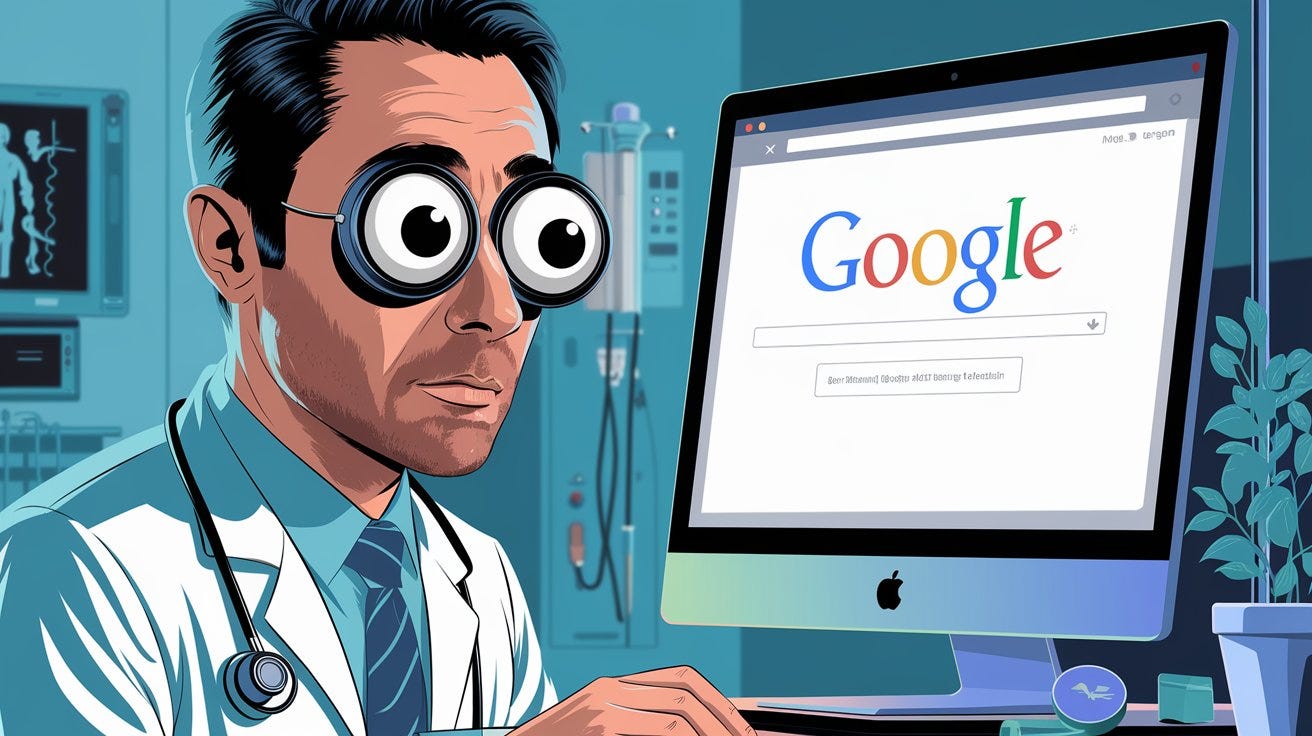
Let's be honest, the mystique surrounding doctors is a magnificent piece of theatre.
We've built them up as these bastions of knowledge, these high priests of the human body. They've spent years in hallowed halls, pouring over textbooks and anatomical diagrams, right? Wrong. What you've got is a highly-trained, glorified algorithm, armed with a stethoscope, a prescription pad, and the internet.
The truth, my friends, is that your GP is not a walking encyclopaedia of medical knowledge. They're more like a highly-skilled customer service operative working their way down a fault-finding checklist. A "Troubleshooting Guide for the Human Vehicle," if you will.
Take the common ailment: the dreaded tummy ache.
You, the hopeful patient, walk in, describing your symptoms with the dramatic flair of a Shakespearean actor. Your GP, meanwhile, is already running a mental checklist. Is it indigestion? Sure, let's throw some antacids at it and see if it sticks. No? Okay, let’s try something slightly stronger. Still no? Right, well, maybe it’s the next one on the list. The whole affair is less about diagnosis and more about trial and error with a side of pharmaceutical roulette.
And before you imagine your GP hunched over ancient tomes, whispering incantations of medical wisdom, let's pull back the curtain further. We live in the digital age, buddy. Where does your GP get all that complex information?
They Google it, just like you, with the same baffled expression on their face as they try to pronounce "gastroenteritis."
They might have spent years in medical school learning all the technical details, but as the years pile up and the relentless tide of new findings crash on their shore, most of that highly complex information has washed away like a sandcastle at high tide, to be replaced by vague memories and the helpful guidance of whichever medical information website is trending that day.
They're basically high-end search engine optimizers, but for your innards.
And really, can you blame them? The human body is a complex machine, and doctors are only mortal. They can't possibly hold every single symptom and ailment in their head, and why should they? The human brain is a valuable thing, so why clutter it up with all that stuff when Google will do it in seconds?
The reality is, your GP is essentially a highly-skilled gatekeeper.
They’re there to play "Symptom Bingo" with you. They go through the motions, trying the basic remedies, and if all the basic boxes are ticked without a solution, then it’s referral time. This is not a slight on them - it’s just the system, which values efficiency over in-depth knowledge. This way the medical system avoids overwhelming the expensive specialists with problems which a quick search could solve.
And let’s not pretend this is a uniquely modern phenomenon.
Medicine has always been a combination of observation, experience, and a lot of guesswork. For centuries, doctors have been prescribing leeches, bloodletting, and various dubious concoctions based on equally dubious theories. So, really, Google is just the 21st-century version of "humours" and "miasmas". At least now they can get their information with fewer leeches.
But what does all of this mean for you, the bewildered patient?
It means you need to take your own health into your own hands, and treat your GP with a healthy dose of scepticism. They are not all-knowing beings, with a vast and detailed knowledge, they are simply part of a complex system, and they will work their way down a list until they get to the appropriate one. They may know more than you about the system, but they do not necessarily know more than you about your own body.
So, the next time you’re in your GP’s office, try to see them for what they are: a skilled, well-meaning but ultimately fallible human, armed with a checklist and an internet connection. And perhaps, just perhaps, a street vendor with a basic first-aid kit and a copy of WebMD could do the same job.
Maybe they just need some training and a prescription pad. Just a thought.
This is not to say that medicine is a fraud, of course, the medical system is essential and has saved millions of lives. But it is to say that the idea of your GP as a bastion of expertise is a myth, and one which we need to be able to question.
So accept your inner sceptic, do your own research, and don’t be afraid to question your medical "expert," because the chances are they're just Googling the answers anyway.