

Victorian Death Photography
When Instagram’s Great-Great-Grandparents Got Weird

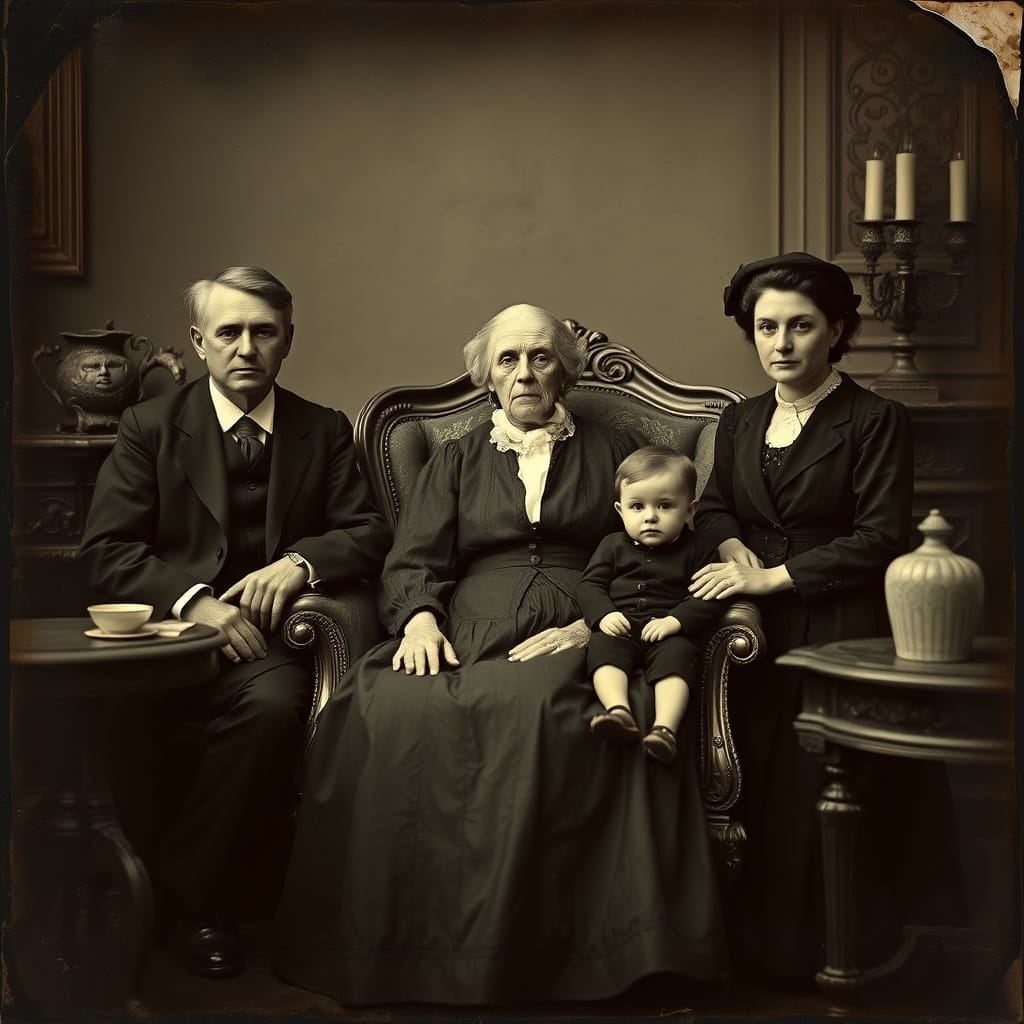
Before you could sob into your Stories about your goldfish’s passing, the Victorians had their own morbid flex: death photography.
Memento mori—Latin for “remember you’ll die,” and boy, did they lean in. They’d prop up their dearly departed in lifelike poses, snap a daguerreotype, and call it a keepsake. Think Grandma in her Sunday best, glassy-eyed, with a kid on her lap who’s clearly wondering why she’s so stiff. It’s Instagram’s great-great-grandpappy, and the parallels to today’s performative grief are too juicy to ignore.
These weren’t candids—oh no, this was *art*.
They’d dress the corpse, comb its hair, sometimes paint pupils on closed eyelids for that “alive” vibe. Families posed with the dead like it was a Sears portrait, smiling while Uncle Fred slumped in a chair, rigor mortis be damned. Why? Sentimentality, sure, but also flexing—photography was new and pricey, so immortalizing your corpse was a status move. “Look at us, we can afford to make death fancy!” Fast-forward to 2025, and it’s a black-square post with “RIP” and a heart emoji—same energy, less formaldehyde.
The creepy factor’s off the charts.
Babies in cribs, eyes open, surrounded by flowers—dead. Teens in wedding poses—dead. One famous shot has a girl “standing” with a hidden frame propping her up, because nothing says “cherished memory” like a taxidermy vibe. Today, we’d call it a horror flick; back then, it was Tuesday. And don’t get me started on the doubles—living twin next to dead twin, like a before-and-after you didn’t ask for.
Now compare: Victorian mom frames her stiff toddler’s pic; you livestream your cat’s funeral with a Venmo link for “treats in kitty heaven.” Both are grief porn, just with different tech. Social media’s “Thoughts and prayers” brigade thrives on the same impulse—make loss public, rack up likes, prove you’re deep. The Victorians didn’t have filters, but they’d have killed for a sepia overlay.
And those influencers crying over their “angelversary”? They’re basically posing with a corpse, minus the corpse.
It’s not reverence—it’s theater. Death pics were keepsakes, sure, but also bragging rights. Today’s equivalent is the curated sobfest, hashtags and all. The Victorians just had better props and worse hygiene.
Next time you see a “Gone too soon” carousel, tip your hat to their spooky ancestors, they started this mess.
---
Creepy indeed. Your post reminded me of a short-lived British mystery tv series on Britbox that centered around a death photographer. Before then, I never knew about this once-popular practice. Thanks for being so informative.